Storm Preparedness
Hurricane Season Tree Prep & Storm Damage Guide for Wilmington, NC
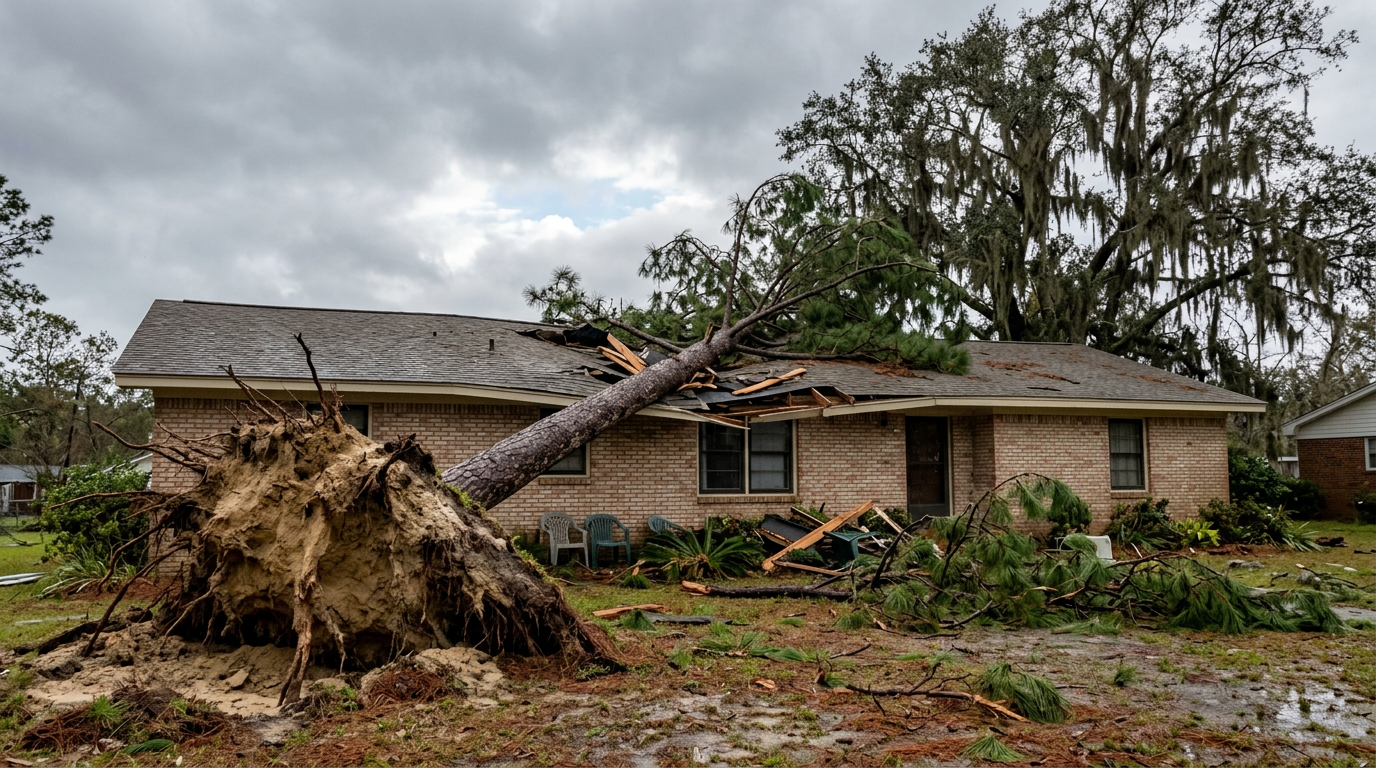
Wilmington knows what a hurricane does to trees. When Hurricane Florence stalled over the Cape Fear region in September 2018, it dumped more than 20 inches of rain on the city and knocked down trees on thousands of homes, roads, and power lines. Two years later, Hurricane Isaias came ashore near Ocean Isle Beach and sent another wave of pines and oaks onto roofs from Brunswick County to Wrightsville Beach.
The problem isn't just the wind. Our iconic live oaks and towering loblolly pines grow in sandy coastal soil that drains fast in a drought but turns to soup after days of tropical rain. Saturated sand can't hold a root plate, so trees that have stood for decades can tip over in gusts they would normally shrug off. That's why the work you do before June 1 matters more than anything you can do once the cone is pointed at Cape Fear.
This guide covers how to spot a hazard tree, what to prune (and what not to), what to do if a tree lands on your house, how North Carolina insurance typically handles it, and how storm debris pickup works in New Hanover County.
Signs a tree is a hazard before a storm
Walk your property with fresh eyes at the start of every season. These are the warning signs our crews see most often on trees that later fail:
- A new or worsening lean. A tree that has always leaned is usually fine. A tree that has started leaning, especially with cracked or mounded soil on the opposite side, is shifting its roots.
- Cracks and splits in the trunk. Vertical cracks, seams, or a split at a V-shaped fork mean the wood is already separating.
- Dead or hanging limbs.Bare, brittle branches with no leaves or peeling bark become projectiles in hurricane winds. Broken “hangers” stuck in the canopy from the last storm are especially dangerous.
- Root heave or root damage. Lifted soil, exposed or severed roots from driveway, septic, or irrigation work, and mushrooms at the base all point to a weakened anchor.
- Limbs over the roof.Even a healthy branch hanging over your house, garage, or pool enclosure is a risk you can remove on your schedule instead of the storm's.
- Decay and cavities. Hollow sounds, soft wood, woodpecker activity, and oozing sap on pines often signal internal rot or beetle damage.
If you notice more than one of these on a tree within striking distance of your home, have it looked at by a professional before the season ramps up.
Pre-storm pruning: what to do and when
Atlantic hurricane season runs June 1 through November 30, with the Cape Fear region's highest risk from mid-August through October. The goal of pre-storm pruning is to let wind pass through the canopy and remove the weak wood that fails first. It is not about making a tree smaller.
What good storm pruning looks like
- Remove dead, dying, cracked, and crossing branches.
- Reduce the length of long, heavy limbs extending over the roof rather than cutting them flush.
- Correct weak V-shaped co-dominant stems on younger trees before they become a split hazard.
- Lightly thin dense crowns so wind can move through instead of pushing the tree like a sail.
What to avoid
- Topping.Cutting a tree's top off produces a flush of weakly attached sprouts that break easily in the next storm.
- Lion-tailing. Stripping all the inner branches and leaving foliage only at the tips concentrates wind load at the ends of limbs.
- Removing more than about 25% of a canopy at once. Heavy cuts stress the tree and invite decay.
Crape myrtles
Crape myrtles are everywhere in Wilmington, and the annual “crape murder” (chopping them back to knuckled stubs) actually makes them more storm-prone, because the thick regrowth is weakly attached. Prune crape myrtles in late winter while dormant, typically February to early March. Remove suckers, crossing branches, and inward-growing shoots, and keep the natural vase shape.
Palms
Sabal palmettos, windmill palms, and pindo palms handle hurricanes well when they are left mostly alone. Remove brown and dead fronds, fruit stalks, and loose boots, but leave the green fronds. The so-called “hurricane cut,” which strips a palm to a few upright fronds, starves the palm and leaves the bud more exposed. A good rule: don't cut green fronds that sit above the imaginary 9 o'clock to 3 o'clock line.
Which Wilmington-area trees fail most in hurricanes
After every major storm, the same species show up on roofs and across roads. University research in the Southeast, along with what we see on cleanup jobs, points to a clear pattern: fast-growing species with weak wood or shallow roots fail far more often than slow-growing, dense-wooded natives.
| Tree | Storm risk | Why |
|---|---|---|
| Loblolly pine | High | Tall, top-heavy crowns on shallow roots in sandy soil. Snaps mid-trunk or uproots when ground is saturated. |
| Water oak & laurel oak | High | Fast-growing, short-lived, and prone to internal trunk decay. Frequently drop large limbs or fail at the base. |
| Bradford (Callery) pear | High | Tight V-shaped branch unions split apart under wind load, often tearing the tree in half. |
| Crape myrtle | Moderate | Generally sturdy, but heavy regrowth from past topping produces weak, easily snapped limbs. |
| Longleaf pine | Moderate | Deep taproot makes it far more wind-firm than loblolly, though trunks can still snap in extreme gusts. |
| Southern live oak | Low | Low, wide crown, dense wood, and a broad root system. Among the most hurricane-resistant trees on the coast. |
| Sabal palmetto (cabbage palm) | Low | Flexible trunk and dense root ball. Fronds may shred, but the palm itself rarely falls. |
The takeaway isn't to clear-cut every pine. A healthy, well-spaced loblolly with good roots can stand for decades. But if you have a tall pine or water oak within reach of your home, it deserves a closer look than the live oak next to it. When replanting after a removal, live oaks, sabal palmettos, longleaf pines, and southern magnolias are strong choices for our coast.
After the storm: what to do when a tree falls on your house
Get everyone out of the damaged area
A tree resting on a roof can shift, and trusses can give way hours later. Leave the affected rooms and don't go into the attic.
Check for gas, water, and electrical hazards
If you smell gas, leave the house and call 911 and your gas provider. Shut off water if a pipe is broken and turn off power at the main if it's safe to reach.
Document everything before anything moves
Take wide and close-up photos and video of the tree, the roof, interior damage, and the stump or root plate. Timestamped photos are the single most useful thing for your insurance claim.
Call your insurance company
Report the claim early; after a hurricane, adjusters get backed up fast. Ask what your policy covers for debris removal and emergency repairs.
Prevent further damage
Most policies require you to take reasonable steps to limit additional damage, such as tarping holes. Keep receipts for tarps and emergency services.
Call a qualified, insured tree company
Removing a tree from a structure is technical rigging work. Ask for proof of liability and workers' comp insurance, and be wary of storm chasers asking for large payments up front.
Does homeowners insurance cover tree removal in NC?
Often yes, but only in certain situations. Here is how most standard North Carolina homeowners policies handle fallen trees. Your policy's exact wording always controls, so read your declarations page or ask your agent.
- Tree hits a covered structure: Damage to the house, garage, shed, or fence is typically covered, and so is removing the tree from that structure, subject to your deductible. Many policies cap debris removal at a set amount per tree or per event, commonly around $500 to $1,000.
- Tree falls in the yard and hits nothing: Removal is usually not covered, even after a hurricane.
- Tree blocks your driveway or accessibility ramp: Some policies include limited coverage for this. It's worth asking.
- Hurricane or named-storm deductible: Coastal NC policies often carry a separate percentage-based deductible (for example, 1% to 5% of your dwelling coverage) that applies to named storms and can be much higher than your standard deductible.
- Neglect: If an insurer can show a tree was obviously dead or decaying before the storm, a claim can become harder. Removing known hazard trees protects you twice.
Our crews routinely provide photos, written descriptions, and itemized invoices formatted for insurance adjusters, which helps claims move faster.
When you need emergency or crane-assisted tree removal
Not every downed tree is an emergency, but some can't wait. Call for emergency service when:
- A tree or large limb is resting on your roof, especially if it has punctured it.
- A tree is blocking the only way in or out of your home or driveway.
- A partially fallen tree is hung up in other trees or leaning toward the house.
- Water is getting into the home because of tree damage.
Why a crane is sometimes the safest option
When a large pine or oak is lying across a house, cutting it in place can make the load shift and cause more damage. A crane lets our crew secure the tree, cut it into controlled sections, and lift each piece up and away from the structure without dropping weight onto the roof. Cranes are also the right call for big trees in tight backyards, over pools and screened enclosures, or where there's no room to fell or lower sections by rope. In many cases, crane-assisted removal reduces total damage and the size of the insurance claim.
Storm debris cleanup: city pickup vs. hiring a pro
After a major, declared storm, the City of Wilmington and New Hanover County typically activate curbside storm debris collection for residents. Rules are announced for each event, so watch the city and county websites and social channels, but the core guidelines are consistent:
- Place debris at the curb in the right-of-way, between the sidewalk and the street, not in the road.
- Separate piles by type: vegetative (limbs, logs, leaves), construction and demolition, appliances, electronics, and household hazardous waste.
- Keep piles clear of power lines, fire hydrants, mailboxes, water meters, and storm drains.
- Don't bag vegetative debris unless instructed; loose limbs and logs are collected by grapple trucks.
- Collection happens in multiple passes over several weeks, so be patient and get debris out before announced deadlines.
When hiring a pro makes more sense
City pickup is for debris residents move to the curb themselves. Debris generated by a paid tree contractor is generally the contractor's responsibility to haul away. Hire a professional when trunks are too large or heavy to move safely, when trees are still standing but damaged, when debris is tangled in fences, pools, or other trees, or when you can't wait weeks for a pickup pass. Chainsaw injuries spike after every hurricane. It's not worth the risk on large wood.
Frequently asked questions
How much does emergency tree removal cost in Wilmington?
Emergency tree removal in the Wilmington area commonly runs from a few hundred dollars for a small tree down in the yard to several thousand dollars for a large pine or oak on a roof. Jobs that need a crane, work near power lines, or after-hours response cost more. Pricing depends on tree size, access, what the tree is resting on, and how much debris needs hauling. Everything Tree NC provides a clear quote before work begins and can document the job for your insurance claim.
Can I remove a tree in Wilmington without a permit?
It depends on where you live and the tree. The City of Wilmington regulates removal of certain protected and significant trees (large live oaks in particular) and trees on lots under development, while unincorporated New Hanover County, Leland, and the beach towns each have their own rules. Trees that pose an immediate hazard after a storm are often allowed to be removed first, but you may need to document the hazard with photos. Check with your city or town planning office before removing a large healthy tree; we can help you figure out whether a permit applies.
When should I prune trees before hurricane season in Wilmington?
Aim to finish hazard pruning before hurricane season starts on June 1. Late winter through spring is ideal for most species. Crape myrtles are best pruned in late winter while dormant. Deadwood and cracked limbs can be removed any time of year, including right before a named storm, if a crew is available.
Should I cut my palm trees back before a hurricane?
Only remove dead or brown fronds and seed stalks. Avoid the tight 'hurricane cut' that strips most green fronds. Green fronds feed the palm and help protect the bud, and over-pruned palms are actually weaker in high wind.
Will homeowners insurance pay to remove a tree that fell in my yard?
Usually not, if it didn't hit anything covered. Most North Carolina homeowners policies pay for tree removal when a fallen tree damages a covered structure like your house, garage, or fence, typically subject to your deductible and a per-tree or per-event limit. A tree that falls in open yard without damage is usually your cost. Always review your specific policy and hurricane deductible.
Who is responsible if my neighbor's tree falls on my house?
In North Carolina, your own homeowners policy generally handles damage to your home, regardless of whose tree it was. Your neighbor may be liable only if they knew, or should have known, the tree was dead or hazardous and failed to act. Written notice to a neighbor about a visibly dangerous tree can matter later.
Will the city pick up tree debris after a hurricane?
After major declared storms, the City of Wilmington and New Hanover County typically run curbside storm debris collection for residents, with vegetative debris separated from construction debris, appliances, and hazardous waste. Debris created by a paid contractor removing a tree is normally the contractor's responsibility to haul away, so ask whether hauling is included in your quote.
24/7 storm response
Tree down or a storm on the way? We're local and on call.
Pre-storm hazard assessments, pruning, emergency removal, and crane-assisted lifts off your roof across New Hanover, Brunswick, and Pender counties.
Areas we serve
- Wilmington, NC
- Leland, NC
- Castle Hayne, NC
- Carolina Beach, NC
- Wrightsville Beach, NC
- Southport, NC
This guide is general information for Wilmington-area homeowners and isn't legal or insurance advice. Permit rules, debris collection details, and policy coverage vary, so confirm with your local government and insurance provider.